Checking a Hashrate Quote on Your Phone Before You Commit
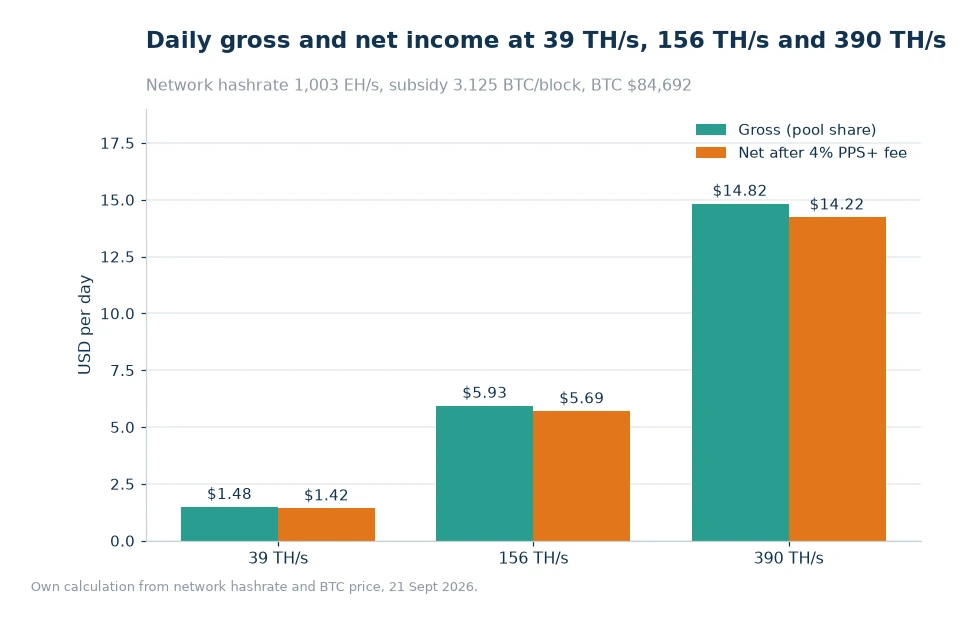
Hashrate offers arrive in a hurry: a message, a call, a number that sounds large. Three tiers are worth memorising because they cover most of the market a small buyer sees. At 39 TH/s the pool credits about 0.00001750 BTC a day, $1.48 at $84,692; 156 TH/s pays $5.93 and 390 TH/s pays $14.82 before the listed 4% comes off.
Key takeaways
- 39 TH/s produces 0.00001750 BTC a day, which is $1.48 gross and $1.42 net at the listed 4%.
- 156 TH/s is four times that, and 390 TH/s is ten times it, so a quote can be ranked in seconds.
- Any offer that cannot state its settlement plan and fee basis is not yet a number you can compare.
- A tenfold hashrate quote should mean a tenfold daily figure, not a tenfold monthly invoice.
The two inputs that decide every quote
Strip away the packaging and a hashrate quote contains two things: a quantity of terahashes and a promise about how they are paid. Everything else, the dashboard, the mobile app, the support line, is presentation. If either of those two is missing, the conversation has not produced a figure yet.
The quantity is easy to sanity-check because the network is public. The payment promise is harder, and it is where most of the difference between two apparently identical offers lives. A plan that pays hourly against current difficulty behaves differently from one that settles after confirmations and shares out the last five rounds. Neither is dishonest. They are simply not the same product, and a quote that does not name one of them is a quote you cannot rank.
Turning the quoted figure into a daily number
The conversion is one multiplication. Divide the offered hashrate by the network total, multiply by 450 BTC a day, then multiply by the coin price. With 1,003 EH/s and $84,692, that collapses to about 0.0000004486 BTC per terahash per day, or 38 cents per terahash per year at today's price. Memorise the daily rate and the phone becomes a calculator. The ViaBTC Mining Calculator does the same job with the fee and power fields attached.
| Quoted hashrate | BTC per day | Gross USD | Net USD | Net per 30 days |
|---|---|---|---|---|
| 39 TH/s | 0.00001750 | $1.48 | $1.42 | $42.68 |
| 156 TH/s | 0.00006999 | $5.93 | $5.69 | $170.71 |
| 390 TH/s | 0.00017496 | $14.82 | $14.22 | $426.79 |
Notice what the table does not include: power, hosting, or the price of the hashrate itself. Those belong in a second pass. The first pass exists only to answer whether the quoted output is plausible. If someone offers 390 TH/s and describes it as worth $40 a day, the arithmetic says otherwise, and the rest of the pitch is now suspect.
What the quote leaves out
Fees are the usual omission. Under PPS+, the block reward carries a 4% charge and transaction fees 2%; under PPLNS, both components are combined at a listed 2%, paid after six confirmations and measured across the last five difficulty rounds. A seller who says "two percent" without saying which plan is quoting the PPLNS headline and applying it to a PPS+ product, or the reverse.
Ask for the settlement plan in writing, then check the listed fee schedule against what you were told. The gap between a 2% and a 4% headline is $0.03 a day at 39 TH/s and $0.30 a day at 390 TH/s. Small in absolute terms, but it tells you whether the person on the phone knows their own product.
The tenfold test
Quotes often come as a ladder: a base unit and multiples of it. Use the ladder as its own check. If the smallest option is 39 TH/s and the largest is 390 TH/s, every dollar figure should be ten times larger, every coin figure ten times larger, and every power figure ten times larger. When one of those ratios breaks, ask why. A tenfold hashrate with only a fourfold power draw is either a much more efficient machine or a mistake in the paperwork.
Run the test in the other direction too. If two offers differ by 4× in hashrate but only 4× in price, the cheaper-per-terahash option is obvious, and the question becomes whether its payment terms are as good. Price per terahash is a useful comparator only after the settlement plan is normalised.
Why the app matters more than the pitch
Once hashrate is pointed at a pool account, the numbers stop being claims and become a live feed. The ViaBTC App shows reported and effective hashrate, credit history and alerts, which is what you actually need during the first week of a new arrangement. A seller who is confident in the offer will not mind you watching the account while you decide.
Watch effective hashrate rather than reported. Reported is what the machine says it is doing; effective is what the pool counted. A gap between them is normal for short windows and suspicious over days. If the gap persists at 5% or more, the offer is delivering less than the number on the call.
Worked example
Suppose the offer is 156 TH/s with a stated 2% fee. Work it from the network down. The share is 156 ÷ 1,003,000,000 = 0.0000001555. Multiply by 450 BTC: 0.00006999 BTC a day. At $84,692 that is $5.93 gross.
Apply the listed 4% that actually applies to the block-reward component under the default plan: 5.93 × 0.96 = $5.69. The difference from the seller's 2% claim is 5.93 × 0.02 = $0.12 a day, or $3.55 over a 30-day month. Over a year it is $42.60, which is not nothing on a 156 TH/s position.
The ladder checks out as well: 39 TH/s returns 0.00001750 BTC and $1.48 gross, four times that is 0.00007000 BTC and $5.93, and ten times the base is 0.00017496 BTC and $14.82. Ten times the base gives 0.00017500 BTC, so the rounding in the quote is a rounding, not a discrepancy.
Then the second pass: at 28 J/TH, 156 TH/s draws 4.37 kW, or 104.8 kWh a day. At $0.06 per kWh that is $6.29, which exceeds the $5.69 net credit. The quote was arithmetically sound and economically empty. That is precisely the finding a phone check is for.
Frequently asked questions
How fast can I convert a hashrate quote to dollars?
In one multiplication. At 1,003 EH/s and $84,692 per BTC, a terahash earns about $0.038 a day gross, so 156 TH/s is roughly $5.93 and 390 TH/s about $14.82 before the listed 4%.
Should I trust a quote that says the fee is 2%?
Only after it names the plan. A listed 2% describes the PPLNS arrangement; default PPS+ takes 4% of the block reward and 2% of transaction fees, which is a different calculation.
What is the difference between reported and effective hashrate?
Reported is the machine's own figure, while effective is what the pool counted over a window. They should converge over hours; a persistent gap means shares are being lost somewhere between the rig and the pool.
Hang up with a number, not a feeling
Before the call ends, write down four things: the hashrate, the settlement plan, the fee basis, and the power assumption. If any of the four is missing, the offer is incomplete and the answer is a polite request to send it in writing. That request costs nothing and filters most of the noise.
Then run the daily figure, subtract the power cost at your own tariff, and compare the remainder with what the hashrate costs. The Profit Calculator will do all of it, but the phone arithmetic is fast enough that you can do it while the person is still talking. That is the whole skill: a quote becomes a decision only after it becomes a daily number.
Sources: ViaBTC pricing, app and calculator pages[1]. Inputs (21 Sept 2026): 1,003 EH/s network, 132.76 T difficulty, 144 blocks daily at 3.125 BTC, BTC priced at $84,692. Published 24 Oct 2026. The 28 J/TH draw and the $0.06 tariff are illustrative.